To remove a Google review, you report it in Google's Reviews Management Tool, and if it's still up after 3 days, you file your one appeal with your explanation and evidence. Google only removes reviews that break its rules, for example fake or off-topic reviews, abuse, or reviews that share personal details. Being negative or unfair is not enough. You can't delete someone else's review yourself: only the author or Google can. The first answer is usually no, so the appeal is where most removals are won.
One unfair review can sit at the top of your profile for months, shaping what every new customer thinks. The good news: in ReviewTactic's 2026 study of 369,688 negative Google reviews, about 1 in 4 (24.3%) broke at least one of Google's rules. Yours may be one of them. This guide shows you how to check, and then exactly what to click, screen by screen.
Which bad reviews can actually be removed
Google doesn't remove reviews for being negative. It removes them for breaking its rules, the Maps User Contributed Content Policy. A real customer's honest complaint will never come down, however many times you report it. A fake or abusive review often can. So before you report anything, find your review in this table. The middle column shows which of Google's reasons you'll pick on the report form.
| Review type | Removable? | Your path |
|---|---|---|
| Competitor, ex-employee, or someone else with a reason to hurt you | Yes: Fake or deceptive | Report → appeal quoting the admission |
| Fake review: it describes something your business doesn't have (a dish, a service, a staff member) | Yes: Fake or deceptive | Report → appeal quoting the review |
| You're sure the person was never a customer, but the review itself doesn't show it | Rarely: Google counts any contact, even a phone call | Report; appeal only with more evidence |
| Off-topic rant (wrong business, second-hand, political, unrelated), ads or gibberish | Yes: Low quality information | Report → appeal |
| Personal attack on named staff, or an unproven accusation of criminal conduct | Yes: Bullying or harassment | Report → appeal |
| Swearing or sexually explicit language | Yes: Profanity | Report → appeal |
| Hate speech or violent content | Yes: Discrimination or hate speech / Harmful | Report → appeal |
| Contains personal information (phone number, address, a third party's details) | Yes: Personal information | Report → appeal |
| Blackmail ("pay me and I'll take it down") | Yes: Fake or deceptive | Report → appeal with the messages attached |
| Low star rating with no text | Rarely in the US; often in the EU | US: report only. EU: legal complaint form |
| Real customer, bad experience | No | Reply + get more good reviews |
| An opinion you disagree with ("food was bad") | No | Reply + get more good reviews |
| Old negative review, no policy violation | No in the US; maybe in the EU if you can't identify the reviewer | Reply + get more good reviews |
| Coordinated review bombing | Partial: some may qualify | Report each one → appeal together |
If your review sits in a Yes row, continue to the report flow below. If it sits in a No row, skip ahead to what to do instead, which is the fix you fully control. For spotting fake reviews specifically, our guide on how to fight fake Google reviews walks through the violations with examples.
Some businesses get far more removable reviews than others. Law firms, medical practices and contractors get a steady stream from people who were never clients, from opposing parties and from competitors. If you run a law firm, see review removal for law firms.
How to report a Google review for removal, step by step
Business owners report reviews in Google's Reviews Management Tool: support.google.com/business/workflow/9945796. You need to be signed in to a Google account that is an Owner or Manager of the Business Profile. Use this tool rather than the Report button on Google Maps: it's the same tool you'll need later to check the status and file your appeal.
Tap or click any screenshot to open it full size.
Step 1: Open the tool and confirm your email
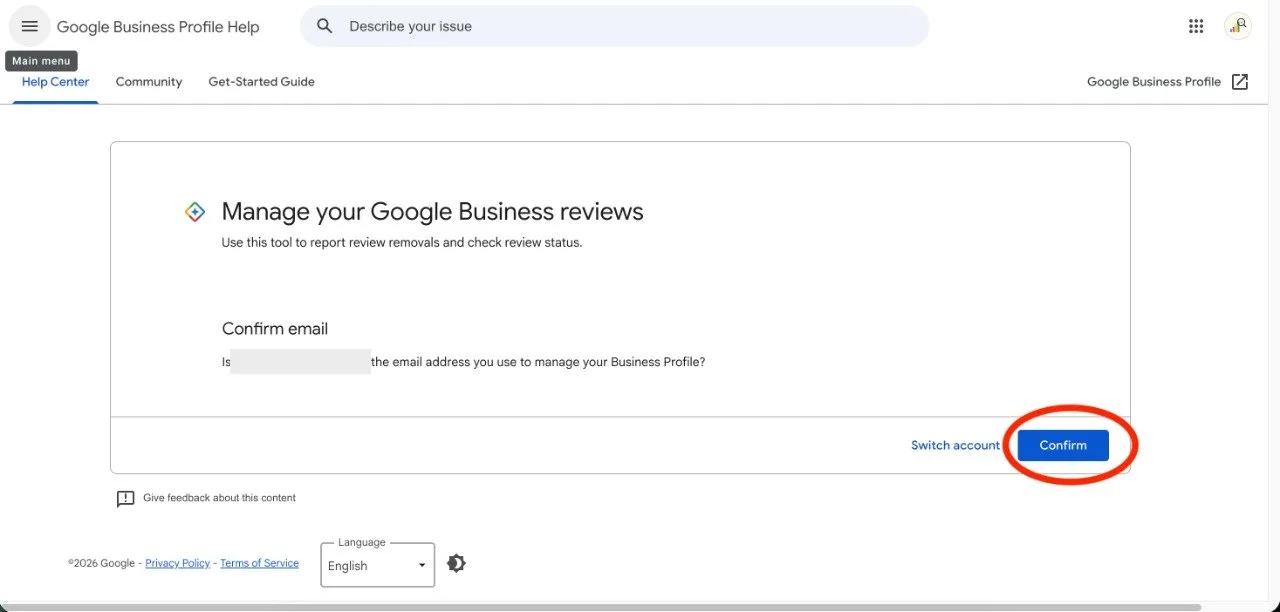
Open the link above. Google shows the email address you're signed in with and asks whether it's the one you use to manage your Business Profile. If it is, click Confirm. If not, click Switch account and sign in with the right one.
Step 2: Choose "Report a new review for removal"
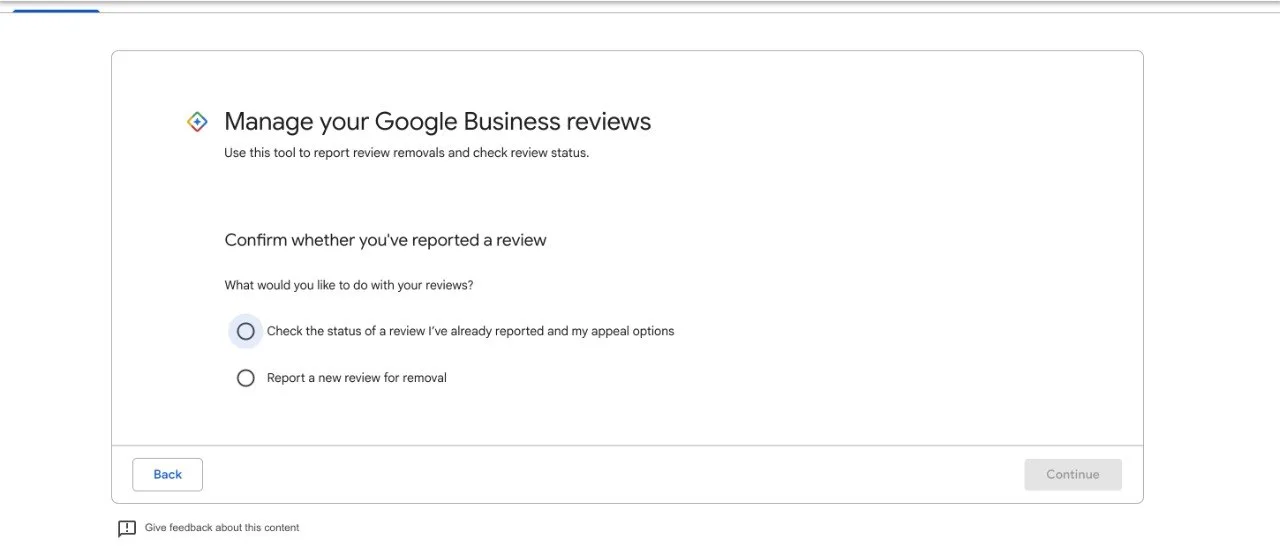
The tool asks what you'd like to do. For a first report, choose Report a new review for removal and click Continue. Remember the other option, Check the status of a review I've already reported and my appeal options: that's where you'll come back to appeal.
Step 3: Pick your business
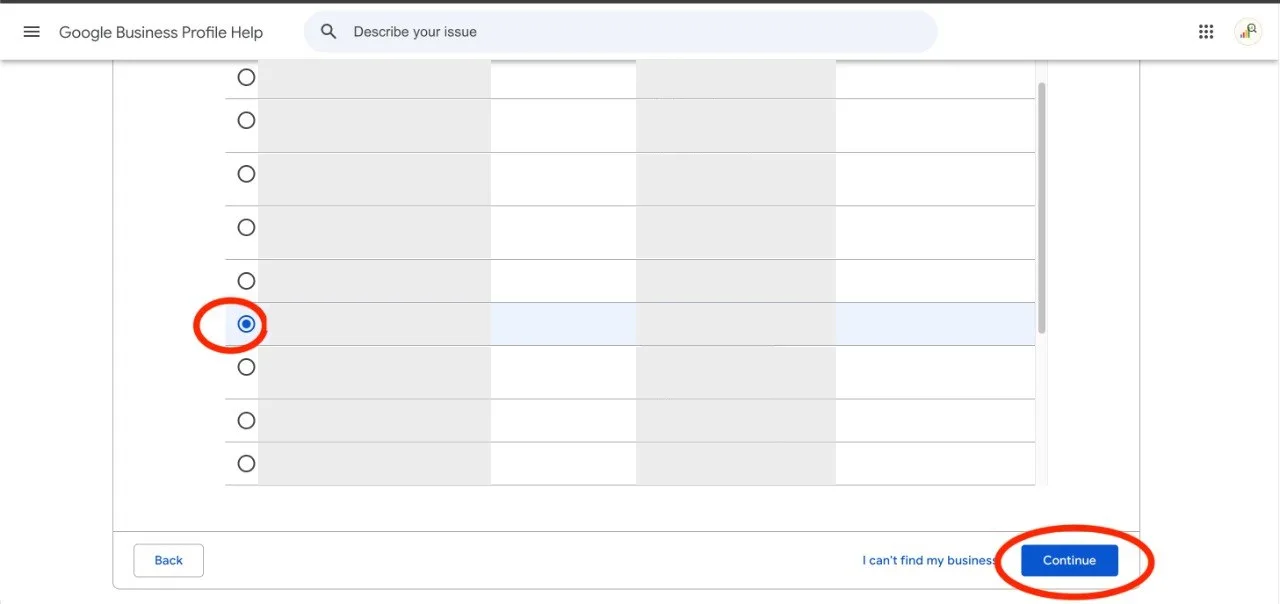
Select the Business Profile the review is on and click Continue. If you manage several locations, check the address. If your business isn't listed, the account you confirmed in step 1 doesn't manage it.
Step 4: Find the review and click Report
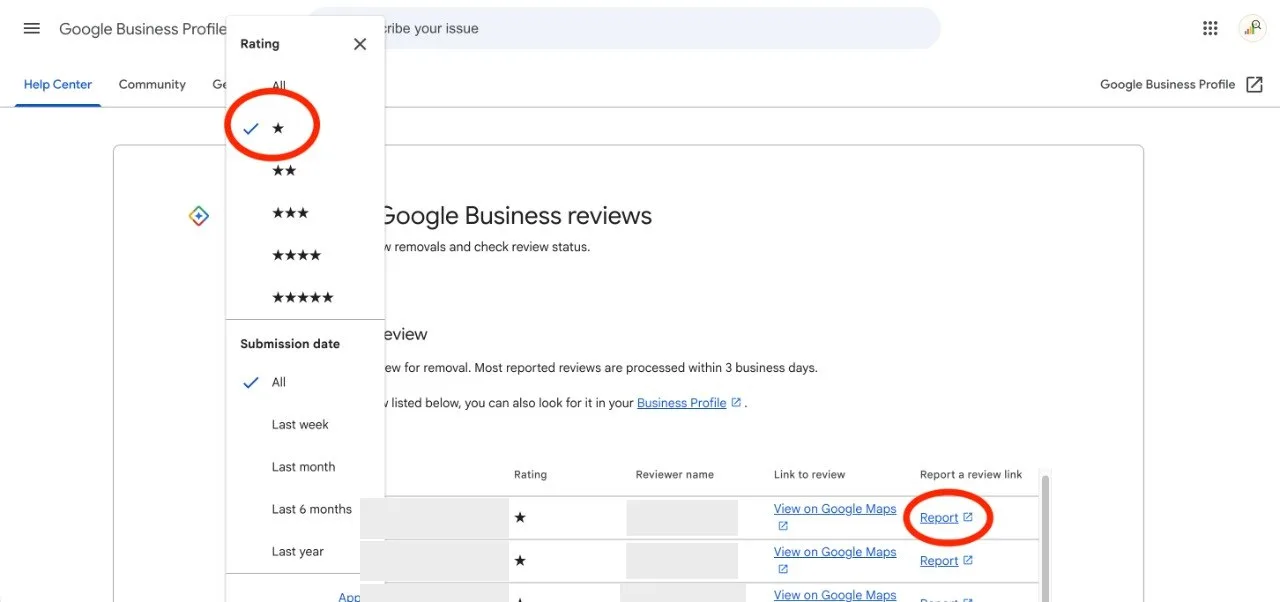
The tool lists your reviews with their rating, reviewer name and a View on Google Maps link. Use the filter to narrow it down (for example, one star only, or the last month), check you have the right review, then click Report next to it.
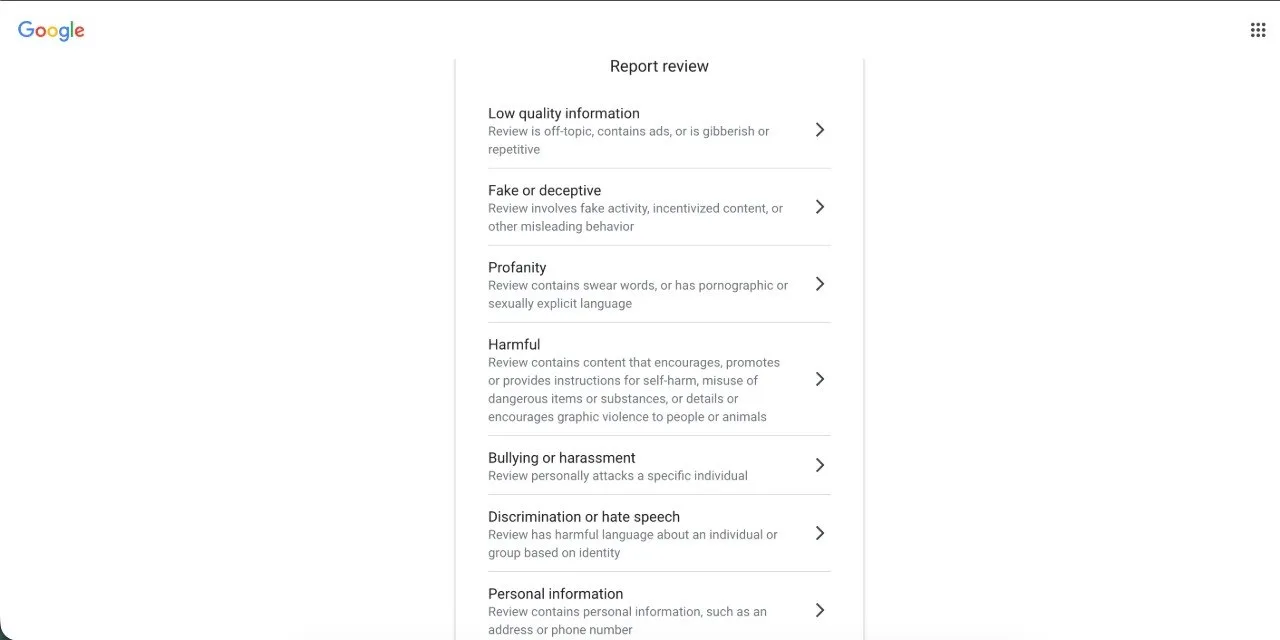
Step 5: Pick the reason
Google offers exactly seven reasons:
- Low quality information: off-topic, contains ads, gibberish or repetitive.
- Fake or deceptive: fake activity, incentivized content, or other misleading behavior. Conflicts of interest (competitors, ex-employees) and extortion go here.
- Profanity: swear words, pornographic or sexually explicit language.
- Harmful: encourages self-harm, misuse of dangerous items, or graphic violence.
- Bullying or harassment: personally attacks a specific individual.
- Discrimination or hate speech: harmful language about an individual or group based on identity.
- Personal information: an address, phone number or other personal details.
Pick the reason the review's own words prove, not the one that matches how you feel about it. A computer checks the review against the reason you picked. If they don't match, the report fails before a person ever sees it.
Step 6: Submit
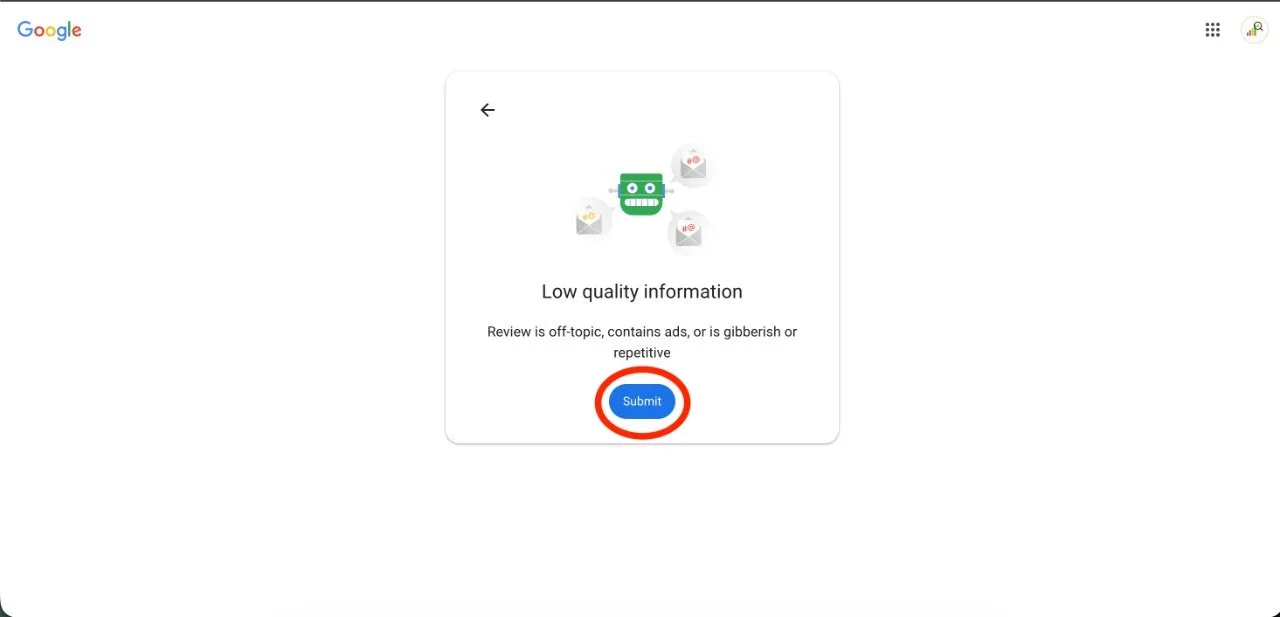
Google shows the reason you picked on a confirmation card. Click Submit. That's the whole report: there is no text box and nothing to attach at this stage, so your explanation and evidence go into the appeal. Screenshot the review before you report it, since it may be edited later.
Google says most reported reviews are processed within 3 business days. Some come down on the report alone, but in our own filings to late September 2026 that happened for only 3 of 52 reviews. So treat the report as the formality. The appeal is where a person actually reads your case.
How to appeal: the one shot you get
You can appeal as soon as the report is rejected, or once it has been pending for 3 days. Don't wait for the rejection: waiting gains you nothing, and the appeal is the first time anyone reads your side. You start it in the same tool as the report.
Step 7: Open your reported reviews
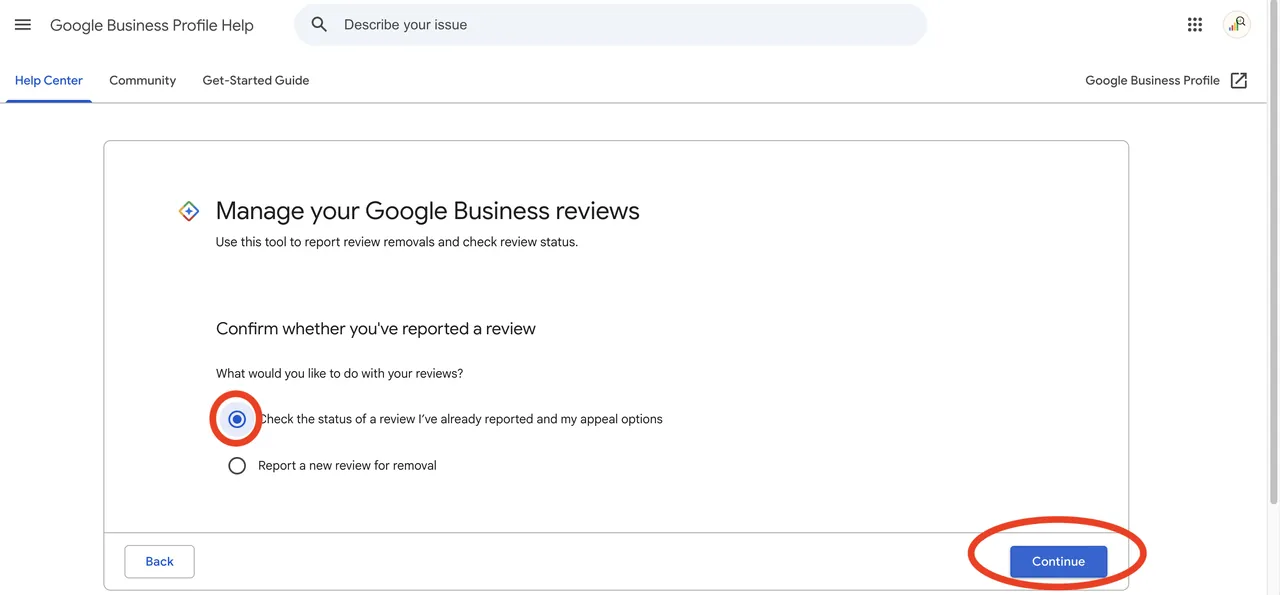
Open the Reviews Management Tool again and confirm your email. This time choose Check the status of a review I've already reported and my appeal options and click Continue, then pick the business if Google asks.
Step 8: Choose Appeal eligible reviews
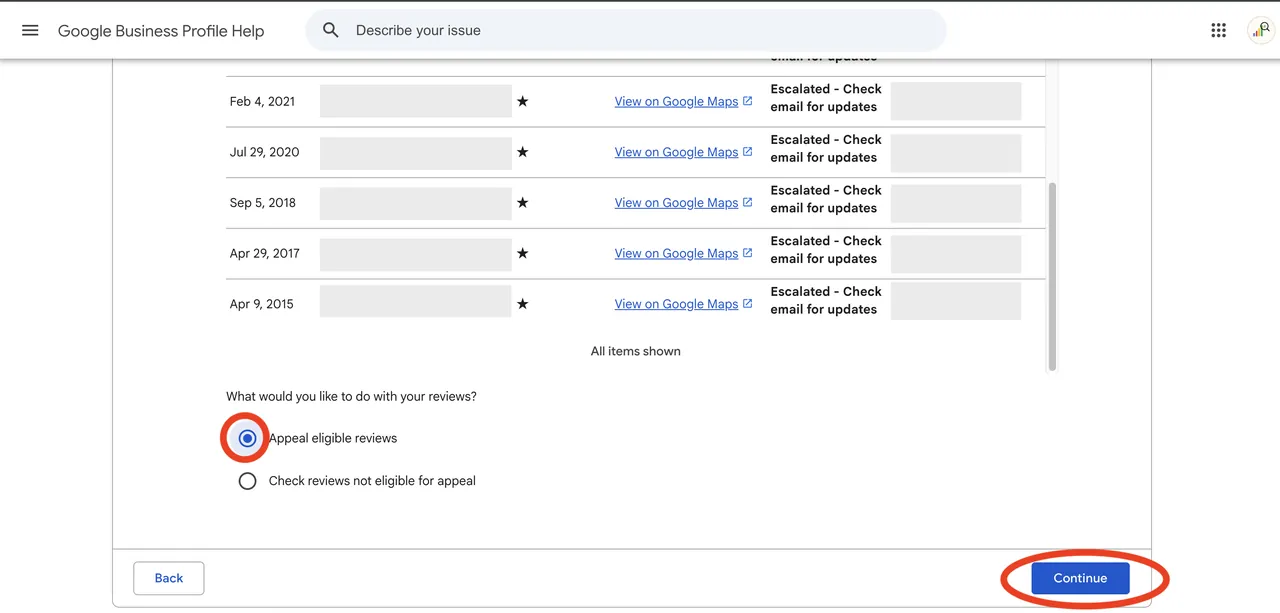
Google lists every review you've reported with its current decision, such as Decision pending or Escalated - Check email for updates. Below the list, choose Appeal eligible reviews and click Continue.
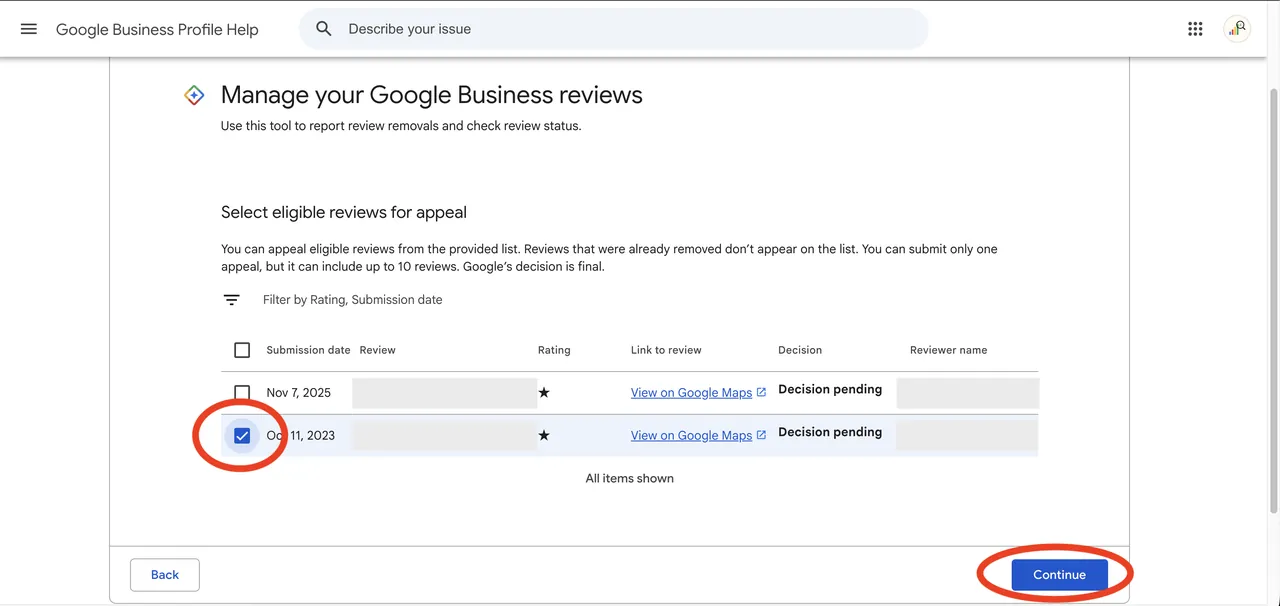
Step 9: Tick the reviews to appeal
Tick the review you want to appeal and click Continue. Reviews that were already removed don't appear here. Read Google's note on this screen carefully: "You can submit only one appeal, but it can include up to 10 reviews. Google's decision is final." If several reviews are fake, tick them together now.
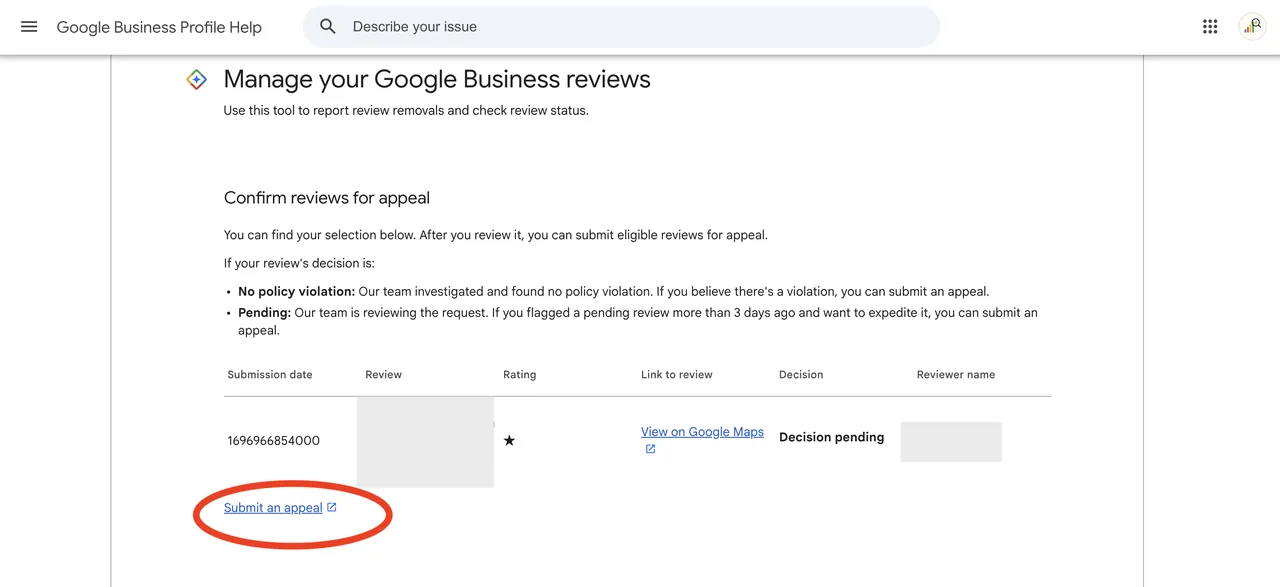
Step 10: Click Submit an appeal
Google shows your selection and explains when an appeal is allowed: when the decision was No policy violation, or when the report is still Pending more than 3 days after you filed it. Click Submit an appeal. The appeal form opens in a new tab.
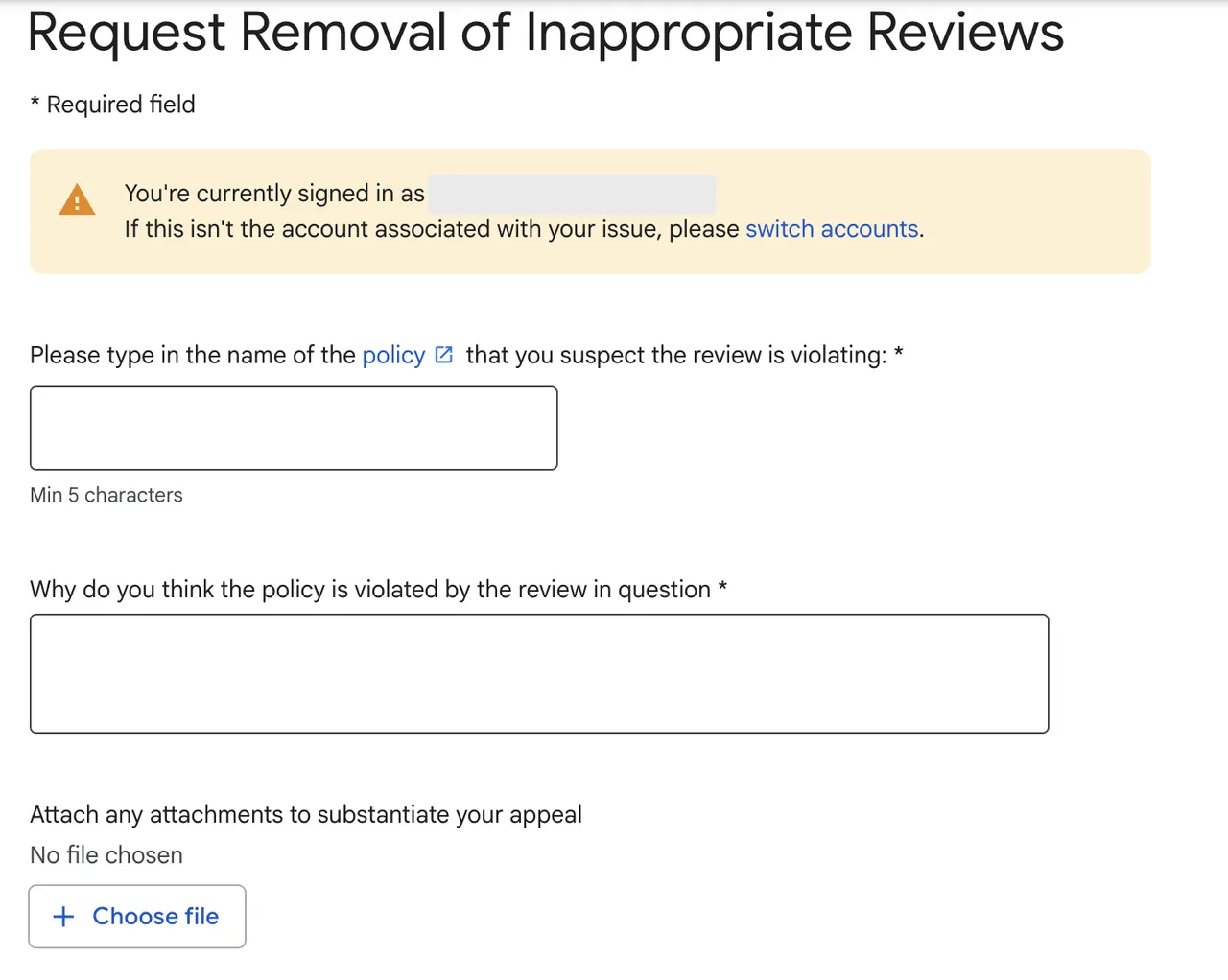
Step 11: Fill in the appeal form
The form, titled Request Removal of Inappropriate Reviews, is where the case is actually made. Check it shows the Google account that manages the profile, then fill in three fields:
- The name of the policy the review breaks, for example "Fake engagement" or "Harassment".
- Why the policy is violated: your explanation, written to the rules below.
- Attachments: the review screenshot and any real evidence you have.
How to write the explanation (three rules):
- You get one appeal per review. Google's decision is final and there's no second try inside the tool, so don't submit until it's right.
- The box holds 1,000 characters, roughly 150 words. Name the rule in the first sentence, quote the review's own words, say in one line why they break that rule, and ask for removal.
- A person reads it, and they only see what you send. They may not be a native English speaker, so keep it plain. Attach the review screenshot and any real evidence (the reviewer's profile, messages, records). Never claim evidence you don't have.
An appeal that fits in the box:
This review breaks Google's Fake Engagement policy: it does not describe a genuine experience with our business. The reviewer writes "the chicken parmigiana was cold and the waiter ignored us for 40 minutes." We have never served chicken parmigiana, and we have no table service; customers order at the counter. Our current menu and a photo of the counter are attached. Please remove the review.
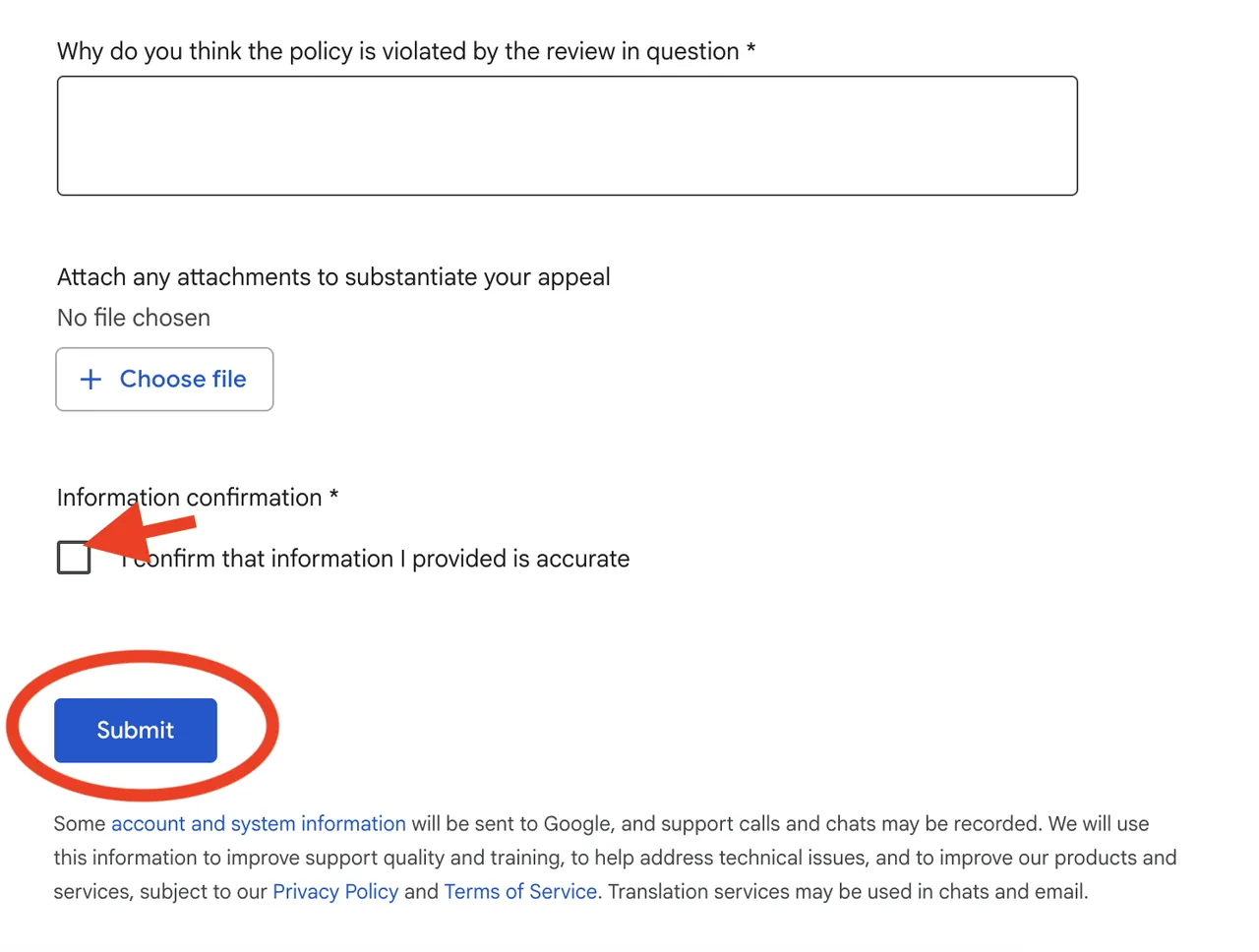
Step 12: Confirm and submit
Tick I confirm that information I provided is accurate and click Submit. Keep the Case ID from Google's confirmation. You'll need it if you escalate later.
What wins: the review's own words. In ReviewTactic's 2026 filings, appeals that quoted the review against a rule about its text (profanity, harassment, off-topic, personal information) won 10 times out of 20. Appeals that argued "this person was never a customer", using only the reviewer's profile, went 0 for 9. Google counts any contact with the business, even a phone call, and doesn't require a purchase.
What happens next: Google replies by email and doesn't say why when it refuses. In our cases, removals after an appeal came through in 1 to 8 days. If you've heard nothing after about 10 days, treat the appeal as refused.
If the appeal is refused
There's no second appeal and no support line for review removals. Google's rejection email comes from a no-reply address and says you can't submit another removal request for that review. The "Remove reviews" option in Google's contact form just sends you back to the same tool. Three options are left.
The Google Business Profile Community Forum
The Google Business Profile Community Forum has Product Experts: experienced volunteers (not Google staff) who can pass a case that looks wrongly decided on to Google. Post the link to the review, your Case ID, a screenshot of the reviewer's profile, and a short, factual reason the refusal was wrong. Keep your customers' details out of it, and answer follow-up questions the same day, or the thread goes quiet.
Google's legal form
Where you are decides how far the law goes:
- EU: often the strongest route of all, and you don't need to report or appeal first. On Google's legal complaint form for Maps (reportcontent.google.com), you state truthfully that you can't find any customer relationship with the reviewer. Google then asks the reviewer to prove they had contact with your business. If they don't answer within about a week, the review comes down, even star-only reviews and ones under a made-up name. The reviewer has six months to object, and the review comes back if they prove the contact. Never claim you can't identify a reviewer you can.
- UK: a notice of complaint under section 5 of the Defamation Act 2013, sent through the legal form, gives Google 48 hours to contact the poster or remove the review.
- US, Canada and Australia: Google's legal form acts on court orders, not on letters. Defamation means a court case proving the review makes false statements of fact, not opinions. Australia also has a concerns-notice procedure under its defamation law.
Ask the reviewer
Only the reviewer can delete or edit their own review. If the complaint names something you can still fix, fixing it and asking often works better than any Google channel. Never offer anything in exchange for a changed review: that is an incentivized review, and it breaks Google's policies on your side.
How long does Google take to remove a review?
| Stage | What to expect |
|---|---|
| Report | Google says most are processed within 3 business days. The first decision is usually a denial. |
| Appeal | File it about 3 days after the report. In our cases, removals came through 1 to 8 days after the appeal. No answer after about 10 days means refused. |
| Community Forum | Depends on the volunteers. Answer their questions the same day. |
| EU legal complaint | The reviewer gets about a week to prove the contact. The reviewer can object for six months. |
| UK section 5 notice | Google has 48 hours to act. |
Two honest truths: removal isn't guaranteed, and the review keeps costing you customers every day it stays up. So while Google decides, work on the part you control, below.
What doesn't work
- Reporting and waiting. The report is checked by an automated system and the first decision is usually a denial. The appeal, with your explanation and evidence, is where the case is actually read, and you only get one.
- Emotional appeals. "This review is destroying our business" doesn't help, and neither does "clearly violates". Google's reviewer needs the policy, the review's own words and your evidence, not feelings.
- Threatening legal action in the appeal. Mentioning lawyers in an appeal doesn't make it stronger. Save legal language for Google's legal form, where it belongs.
- Paying "guaranteed removal" services. Some charge hundreds of dollars or more upfront and use the same free tools you have. Some are outright scams. Reporting and appealing are free.
- Doing nothing. Reviews don't expire. They sit on your profile affecting your rating, your ranking, and every customer's first impression, indefinitely.
What to do with bad reviews that can't be removed
Most bad reviews are from real customers with real complaints. They don't break any rule and they won't come down, however many times you report them. But they don't have to define your business. Two things work:
1. Respond publicly
A calm, professional reply to a bad review does something powerful: it tells every future customer reading your profile that you handle problems well. The reply is for them, not the angry reviewer. Keep it to 3-4 sentences: thank, apologize for the experience, address the issue briefly, and offer to resolve it offline. For templates and a full framework, see our guide on how to respond to bad Google reviews.
2. Outweigh it with new reviews
One bad review among 200 good ones barely moves your average. The fix you fully control is getting more reviews: ask every happy customer, use a one-tap review link or QR code, and automate the ask so it happens after every visit. A business with a steady flow of genuine five-star reviews is far less vulnerable to any single negative one.
Want to see how exposed you are right now? Run a free review audit, no signup and about 10 seconds, to see your current rating, review velocity, and how one bad review is affecting your average.
Review bombing and coordinated attacks
If you've received a sudden flood of bad reviews, from competitors, angry internet communities, or extortion attempts, the situation is different from a single bad review. Some of these reviews may qualify for removal individually (fake engagement, conflict of interest), but the volume makes reporting them one by one slow.
For coordinated attacks:
- Document the pattern: screenshot timestamps, reviewer profiles, and any threatening messages. A clear pattern of coordinated activity strengthens every individual removal request.
- Report each review, then appeal them together: one appeal can cover up to ten reviews, so describe the pattern once and attach the evidence. Google may also pause new reviews on a listing under attack and show a notice on your profile while it cleans up.
- Report extortion: if someone is threatening bad reviews unless you pay them, report the reviews as Fake or deceptive and use Google's separate extortion report form. Attach the threatening messages to your appeal. Never pay.
- Escalate on the forum: if the appeal is refused, post the pattern on the Google Business Profile Community Forum with your Case ID.
For the full playbook, see our review bombing and extortion protection guide.
Should you hire a removal service?
Removal services use the same free tools available to any business owner: Google's report form, the one appeal, and the forum and legal routes after it. What they add is experience: which of the seven reasons to pick, how to fit the case into 1,000 characters, and which evidence actually wins.
When a removal service makes sense:
- You have several reviews that break Google's rules and don't have time to report and appeal each one yourself.
- You haven't appealed yet and want the one appeal you get per review to be as strong as it can be.
- You're dealing with a review bombing attack and need bulk removal support.
When it doesn't:
- The bad reviews are from real customers. No service can remove legitimate complaints.
- The service charges upfront and keeps the money if the review stays up.
- The service promises "guaranteed removal". No one can guarantee what Google will do.
Prices, methods and success rates for seven different approaches are laid out in our Google review removal services comparison. If you want the pay-per-result option, our own Google review removal service is $99 per removed review and free to audit.
How common are removable reviews?
More common than most owners expect. Across 369,688 negative reviews from 15,954 business profiles, 24.3% broke at least one Google content policy, and 81.8% of those businesses were carrying at least one. Spam alone accounted for 41.2% of every violation found. The full methodology and the category-by-category breakdown are in our 2026 Google review policy violation study.